 Whimsy
← Journal
Whimsy
← Journal
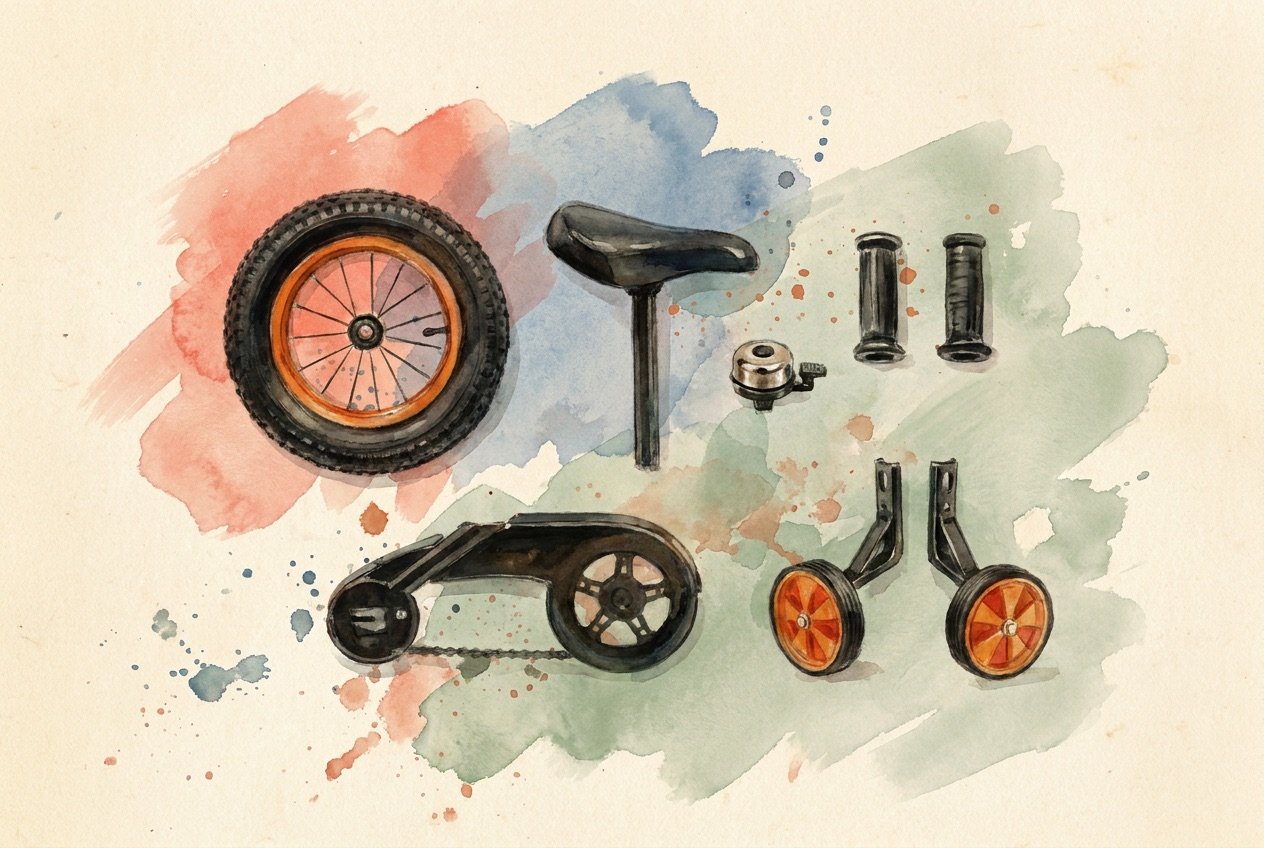
Walk into any bike shop as a parent and you'll be handed a small foreign language: standover heights, coaster brakes, freewheels. None of it is complicated — it just sounds that way. Here's every term you're likely to meet, in plain English.
Balance bike
A bike with no pedals at all. A child straddles it and pushes along with their feet, which lets them learn the genuinely hard part of cycling — balance — through play, with both feet always able to touch the ground. Most kids who start here skip training wheels entirely.
Wheel size
How kids' bikes are measured. A "16-inch bike" means the wheels are 16 inches across — it says nothing about the frame. Kids' sizes run roughly 12" to 24"; adult bikes switch to frame-size measurements instead, which is why the numbers suddenly change meaning when they grow up.
Standover height
The gap between the bike's top tube and your child when they stand over it, flat-footed. This matters more than the age printed on the box: if they can't stand over the bike with both feet on the ground, it's too big — whatever the label says.
Training wheels (stabilisers)
The little bolt-on side wheels that hold a pedal bike upright. They let a child pedal before they can balance — useful for confidence, though most kids who begin on balance bikes never need them. Younger than you'd think: they only appeared in 1949.
Coaster brake
A brake inside the rear wheel that works when the rider pedals backward. Common on smaller kids' bikes because small hands can find levers hard to squeeze. Simple, low-maintenance, and slightly startling the first time an adult tries one.
Hand brake
The familiar squeeze-lever brake. On a kids' bike the lever's reach and stiffness matter enormously — a brake a child can't squeeze isn't a brake. Look for levers set close to the grip and easy to pull with four small fingers.
Freewheel
The mechanism that lets a bike coast — wheels turning, pedals still. Bikes with coaster brakes don't fully have this (pedalling backward brakes instead), which is why freewheeling arrives together with hand brakes as kids move up in size.
Steel vs aluminum
The two frame materials you'll meet. Steel is sturdy, forgiving and takes a beating — ideal for first bikes that get dropped daily. Aluminum is much lighter, which matters once kids ride further and lift the bike themselves. That weight difference is the single biggest thing you feel between bikes.
Kickstand
The fold-down leg that holds a parked bike upright. Not standard on every kids' bike — worth checking if your driveway currently doubles as a bike graveyard.
That's the whole language. If a shop ever makes it sound more complicated than this, the bike is probably being sold harder than it needs to be — a good kids' bike explains itself the moment your child gets on it.