 Whimsy
← Journal
Whimsy
← Journal
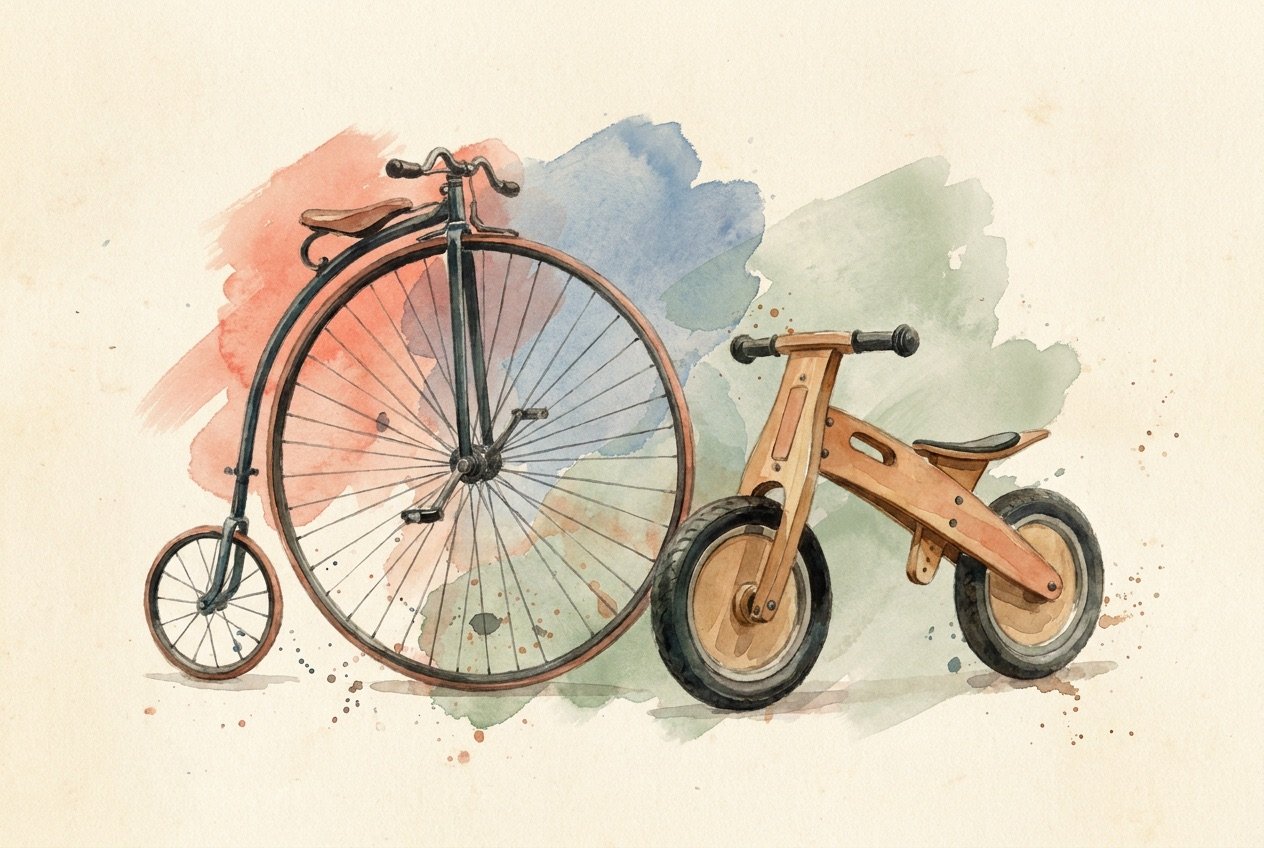
Here is a secret hiding in plain sight in every toy shop: the children's bicycle is not a shrunken copy of the adult one. For two hundred years it has been the other way round. The smallest bikes have repeatedly arrived first — and the grown-up bicycle world has followed them.
1817: It begins without pedals
The ancestor of every bicycle on Earth had no pedals at all. In 1817, the German inventor Karl von Drais unveiled his Laufmaschine — the "running machine" — a wooden two-wheeler that riders straddled and pushed along with their feet. It was steerable, it balanced on two wheels in line, and it worked.
If that sounds familiar, it should. A modern balance bike is, in spirit, a direct descendant of the very first bicycle. When a toddler scoots along on a pedal-less bike today, they are re-enacting the founding moment of cycling itself. The industry spent two centuries adding things to Drais's idea — and then, for its youngest riders, wisely took most of them back off.
The 1860s–1880s: Pedals, and a problem of size
Pedals arrived in the 1860s with the French velocipede, better known as the "boneshaker" for reasons any of its passengers on cobblestones could explain. Then came the towering penny-farthing, whose enormous front wheel was the only way to go fast before chains and gears existed. None of this was any good for children — the machines were heavy, tall and frankly dangerous even for adults.
The breakthrough was John Kemp Starley's "safety bicycle" of 1885: two equal-sized wheels, a chain drive to the rear wheel, and a diamond frame. It is essentially the bicycle we still ride today. And crucially, it could be scaled. For the first time, making a bicycle smaller didn't mean making it a different, stranger machine. The children's bicycle became genuinely possible.
The early 1900s: Kids get their own wheels
With safety bicycles and the pneumatic tyre (thank you, John Boyd Dunlop, 1888 — a tyre he developed after watching his young son rattle around on solid rubber), manufacturers in the early twentieth century began building bicycles specifically for children rather than merely small adults' models. Tricycles boomed as nursery staples. Sidewalk bikes appeared with solid tyres and simple construction.
The children's bike also picked up its most important accessory in this era: the training wheel. Stabilisers became widespread in the mid-twentieth century and, for two or three generations, defined how almost everyone learned to ride — pedal first, balance later. Remember that order. It's about to be reversed.
Mid-century: The bicycle becomes childhood furniture
In the decades after the Second World War, as cars took over adult transport in much of the world, the bicycle found its most devoted audience: children. The bike under the birthday ribbons became one of the defining objects of a twentieth-century childhood. Designs grew playful — streamlined frames styled like rockets and motorcycles, banana seats, tassels, baskets, bells.
Then, in 1970s California, kids on modified cruisers started racing around dirt tracks pretending to be motocross riders — and invented BMX. It is a perfect example of the pattern: children didn't wait for the industry to design the bike they needed. They created a whole discipline first, and the industry scrambled to catch up.
The 2000s: The balance-bike renaissance
The biggest shift in how children learn to ride in a hundred years arrived quietly, in the late 1990s and early 2000s, when modern balance bikes began spreading from Europe across the world. The idea was radical only in the sense that it was very old: remove the pedals, lower the seat, and let the child solve balance — the genuinely hard part of cycling — through play, at their own pace, with both feet always able to touch the ground.
It worked astonishingly well. Children who start on balance bikes routinely skip training wheels entirely, transferring to pedal bikes in days rather than months, often years earlier than the training-wheel generations managed. The stabiliser, it turned out, had been teaching the wrong skill first — pedalling, which is easy — while postponing balance, which is the whole game.
Karl von Drais, two centuries on, would have recognised the solution immediately.
What two hundred years teaches us
Reading the history of the children's bicycle, one lesson keeps repeating: the best ideas start from how children actually move, play and learn — not from shrinking down whatever the adults are riding. The running machine, BMX, the balance bike: each one came from meeting young riders where they are.
That's the tradition we try to build in. Whimsy makes exactly two models, each designed around a stage of that very old, very magical process of a person and two wheels figuring each other out. It's a small contribution to a two-hundred-year story — but it's a good story to be part of.