 Whimsy
← Journal
Whimsy
← Journal
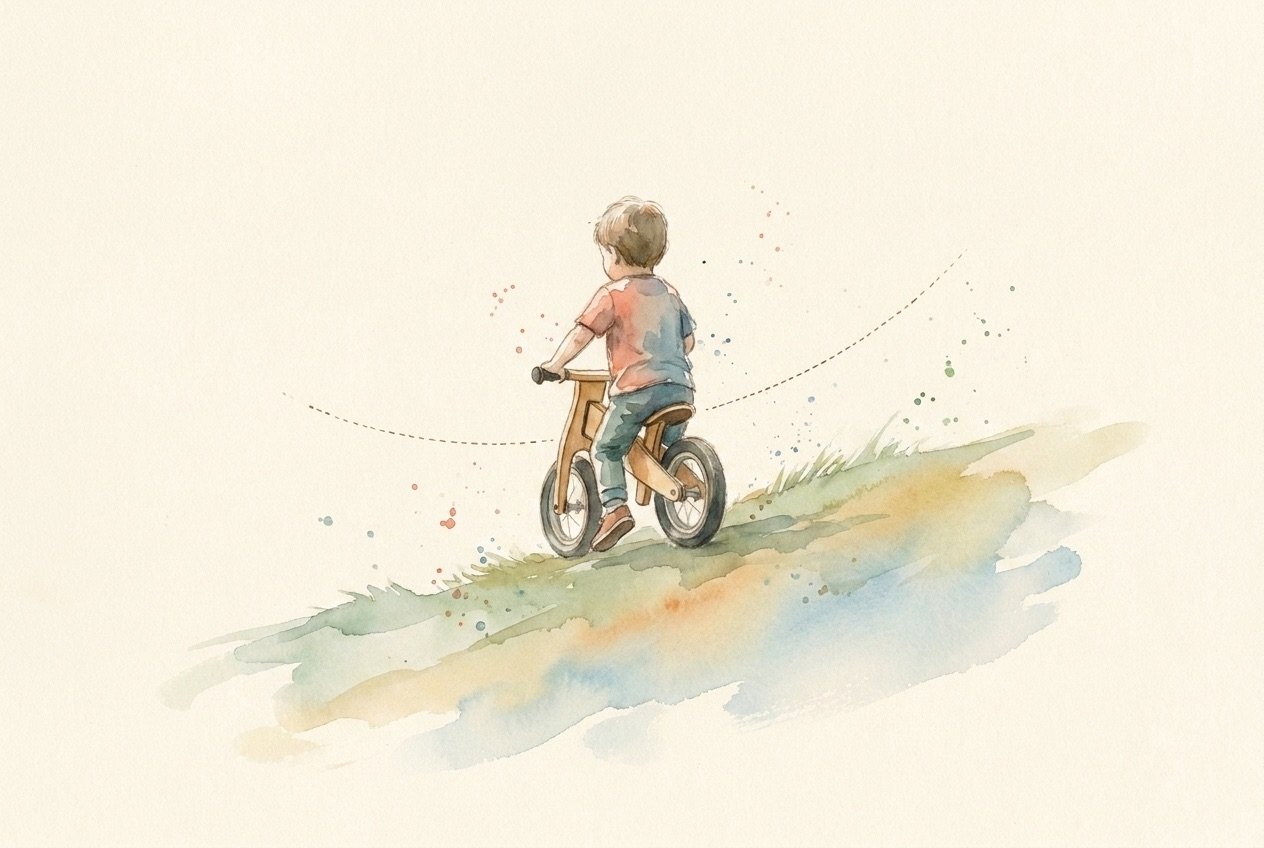
Watch a child learn to ride a bicycle and you are watching one of the most sophisticated things a human brain ever does — disguised as a Tuesday afternoon in the park. Here is what's really going on under the helmet.
First, appreciate the problem
A bicycle is an unstable machine. Left alone, it falls over; that's its resting state. Keeping one upright means constantly steering the wheels back underneath a centre of gravity that never stops moving — dozens of micro-corrections a minute, each made before the rider is consciously aware a correction was needed.
Adults forget this because our corrections became automatic decades ago. But a five-year-old at the top of the driveway is being asked to solve, in real time, a control problem elegant enough that engineers still write research papers about why bicycles behave the way they do.
The three systems that have to agree
Balance isn't one sense; it's a committee. The vestibular system — tiny fluid-filled canals in the inner ear — reports which way is down and how the head is tilting and turning. The eyes report the horizon and oncoming flowerpots. And proprioception — the body's internal map of where its own limbs are — reports what the hands, hips and feet are doing without anyone needing to look.
In young children these three systems are still learning to work as a team. That's a big part of why learning to ride takes time: the child isn't just learning a skill, they're calibrating hardware. Every wobble is a data point. Every save is the committee reaching agreement a little faster than last time.
Why the wobble suddenly disappears
Learning to ride doesn't build up gradually and evenly, and every parent has seen the proof: weeks of wobbling, and then one afternoon — click — a rider. What happened?
The skill moved house. Early practice is managed by the brain's effortful, conscious control systems, which are slow and easily overloaded ("pedal-steer-brake-LOOK OUT"). With repetition, the pattern gets handed over to the cerebellum and the brain's automatic motor circuitry — the same basement machinery that runs walking. Once the handover happens, balance stops costing conscious attention. The child isn't thinking "balance" anymore, which is precisely why it works. The wobble doesn't fade; it switches off.
This is also why riding a bike, once learned, is nearly impossible to forget. Skills stored in that automatic circuitry — researchers call it procedural memory — are extraordinarily durable. "It's like riding a bike" is a neuroscience finding wearing a folk-saying costume.
Why balance-first works better
Riding a bike is really two skills stapled together: balancing and pedalling. Pedalling is easy — toddlers manage it on tricycles. Balancing is the hard part, the part that needs all that neural calibration.
Training wheels teach the easy skill first and put the hard one on hold. Worse, they teach some anti-lessons: a bike on stabilisers steers like a tricycle and leans the wrong way in corners, so some of what the child grooves in has to be un-learned later.
A balance bike flips the order. With no pedals and both feet free to catch every stumble, the child works directly on the hard skill from day one — at walking pace, at their own initiative, with the ground reassuringly close. By the time they graduate to pedals, the difficult half of cycling is already automatic. That's why balance-bike kids so often ride off on their first or second pedal attempt, and why they tend to get there younger.
What parents can actually do
Less than you'd think, and that's good news. The learning happens inside the child's nervous system and cannot be rushed from the outside — but it can be given the right conditions. Short, frequent, playful sessions beat long determined ones. Flat, open, slightly-soft ground beats narrow paths with an audience. And the hardest one: resist the urge to hold the bike. Every stumble a child catches themselves is worth ten wobbles a parent prevents, because the catch is the actual lesson.
Then one day the committee agrees, the skill moves into the basement, and a small person goes flying down the path shouting the news to the whole neighbourhood. Two hundred years of bicycle history, several branches of neuroscience, and the best afternoon of the year — all in one spin of the wheels.
Whimsical, we'd call it.